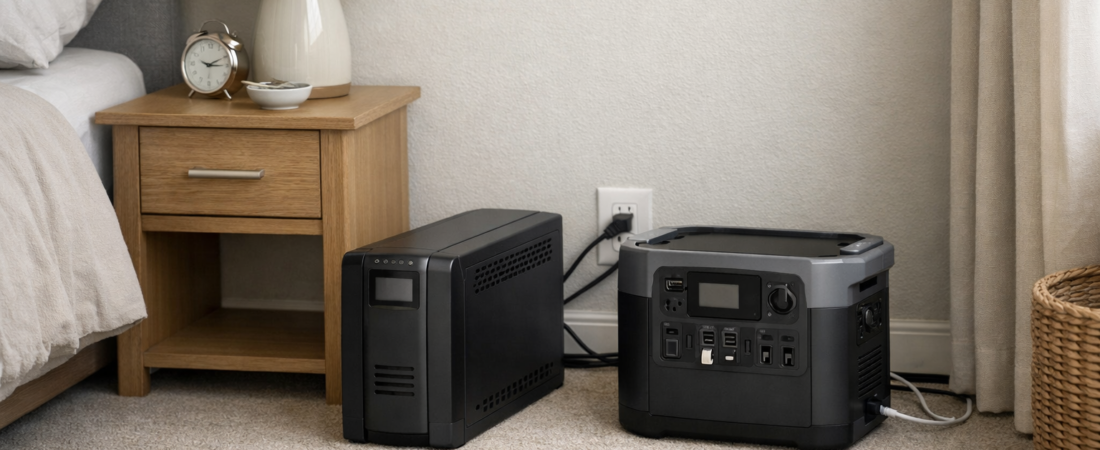
People who rely on electrically powered medical equipment often hear two backup options mentioned: UPS systems and portable power stations.
Both provide battery-based electricity during outages.
But they are built for different purposes, and understanding that difference is important for reliability planning.
This article explains how each system works, where each performs best, and how to think about them in a residential medical reliability plan.
For a broader overview of battery systems used in medical planning, see Battery backup systems explained for medical needs.
What Is a UPS?
A UPS (Uninterruptible Power Supply) is designed to provide instant, automatic power when grid electricity stops.
It is typically:
-
Plugged into a wall outlet
-
Connected directly to one device (or a small group of devices)
-
Designed for short-duration outages
UPS systems are commonly used for:
-
Desktop computers
-
Networking equipment
-
Small electronics
In medical contexts, they are sometimes used to support:
-
CPAP machines
-
Oxygen concentrators
-
Monitoring devices
The key feature of a UPS is zero or near-zero transfer time. When power fails, the device switches to battery immediately.
That instant transition can be important for equipment that does not tolerate even brief interruptions.
What Is a Portable Power Station?
A portable power station is a larger battery unit that stores energy and delivers it through built-in AC outlets and DC ports.
It is typically:
-
Charged in advance from a wall outlet
-
Recharged from solar panels (optional on some models)
-
Capable of powering multiple devices
Portable power stations are often used for:
-
Home outage backup
-
Recreational use
-
Small appliance support
In medical settings, they may support:
-
CPAP machines
-
Oxygen concentrators
-
Feeding pumps
-
Mobility charging equipment
Unlike most UPS systems, portable power stations usually do not switch instantly when grid power fails unless configured in a pass-through mode. Even then, transfer times vary.
Transfer Time: Why It Matters
One of the biggest differences between the two systems is how quickly they switch to battery power.
A UPS is built for uninterrupted operation.
A portable power station may introduce a brief delay when switching.
For some medical devices, even a short interruption can trigger:
-
An alarm
-
A restart sequence
-
A shutdown
Understanding whether the specific equipment tolerates brief power interruptions is an important part of planning.
Runtime Differences
UPS systems are usually designed for minutes, not hours.
They are meant to:
-
Keep a device running long enough to shut down safely
-
Bridge short outages
Portable power stations are typically designed for longer runtimes, depending on battery capacity and device load.
For medical planning, runtime expectations should be realistic.
Battery capacity, device wattage, and efficiency all affect how long equipment can operate.
Output Capacity and Equipment Compatibility
UPS systems generally have lower wattage limits.
They are ideal for:
-
Low to moderate draw equipment
-
Electronics with stable power needs
Portable power stations often support higher output loads and multiple devices at once.
However, compatibility depends on:
-
Continuous wattage rating
-
Surge capacity
-
Pure sine wave output
Sensitive medical equipment should only be connected to systems that provide stable, clean power output.
Charging and Recharging
UPS systems recharge automatically when connected to grid power.
Portable power stations require:
-
Manual charging
-
Time to reach full capacity
Some units support solar charging, which may extend outage resilience during extended disruptions.
Planning should account for recharge time and access to electricity.
Noise and Placement Considerations
Both systems may include cooling fans.
In quiet residential settings, noise levels may matter, particularly for bedroom equipment such as CPAP devices.
Placement considerations include:
-
Ventilation space
-
Avoiding trip hazards
-
Keeping cords organized
-
Preventing moisture exposure
Backup systems should be positioned in a way that supports safety and accessibility.
When a UPS May Be More Appropriate
A UPS may be more appropriate when:
-
Equipment cannot tolerate brief interruptions
-
Outages are typically short
-
The goal is seamless automatic protection
It functions well as a protective buffer.
When a Portable Power Station May Be More Appropriate
A portable power station may be more appropriate when:
-
Longer runtime is needed
-
Multiple devices require support
-
Flexibility and portability matter
-
Solar recharging is part of the plan
It functions more like a temporary off-grid power source.
Layered Planning
In some situations, layered systems are used.
For example:
-
A UPS ensures uninterrupted switching
-
A larger battery system provides extended runtime
This type of planning depends on:
-
Equipment sensitivity
-
Risk tolerance
-
Budget
-
Professional guidance
Medical power reliability is not about choosing the most powerful system.
It is about choosing the most appropriate one.
Professional Guidance and Boundaries
Electrical loads, battery sizing, and equipment compatibility can be complex.
This article provides educational information only.
Specific equipment decisions should be discussed with:
-
The medical equipment provider
-
A licensed electrician
-
The device manufacturer
Clear planning reduces uncertainty and improves reliability over time.
Conclusion
UPS systems and portable power stations both play roles in residential medical power planning.
A UPS prioritizes uninterrupted switching.
A portable power station prioritizes extended runtime and flexibility.
Understanding these differences supports informed, calm decision-making — which is the foundation of medical power reliability.